
Understanding Lafayette Parish Releases
A Lafayette Parish custody endpoint can mean several things. Someone may leave the Lafayette Parish Correctional Center after bond, dismissal, sentence satisfaction, or another court-authorized release. The same person may instead move to the Louisiana Department of Public Safety and Corrections, another parish jail, a federal custodian, immigration custody, treatment, or another lawful placement. Only the first group is clearly back in the community. The Lafayette Parish Sheriff’s Office custody event records what happened at LPCC, while the court record explains the legal basis. A receiving locator may show that confinement continued elsewhere.
That distinction matters because a live roster is built to show current custody, not past release events. Once physical LPCC custody ends, a person will normally drop from the current-custody view. Absence is a clue, never a complete release record. A reliable conclusion joins the release time or disposition maintained by LPSO with court minutes, Louisiana Automated Victim Notification System data, or the locator used by the next custodian.
- Release
- The end of physical custody by one agency. Another agency or supervision may still follow.
- Transfer
- A move between custodians. It is not release to the community.
- Parole
- Community supervision after imprisonment, usually for the balance of a sentence.
- Discharge
- The recorded end of the applicable sentence or supervision term.
Lafayette Parish Release Outcomes
The recorded outcome controls the next search. Bond can end jail custody while the criminal case remains open. Time served or a satisfied sentence should be tied to court minutes and the actual sheriff release entry. Parole ends physical imprisonment but not the sentence. A transfer ends LPCC custody without ending confinement. The table keeps those paths separate.
| Recorded outcome | Meaning | Best next source |
|---|---|---|
| Bond or court release | LPCC custody may end while the case continues | LPSO release entry and Lafayette Clerk minutes |
| Time served or sentence satisfied | The sentence or credited jail term reached its endpoint | Court disposition plus actual release time |
| Parole | Physical prison custody ends under community supervision | LAVNS and assigned Probation and Parole district |
| Probation | A court-ordered community sentence, with or without prior jail time | Court minutes and current district assignment |
| Transfer or hold | Another parish, DPS&C, USMS, BOP, or ICE may take custody | The receiving system and transfer record |
| Final discharge | The state custody or supervision term has ended | DPS&C discharge date when applicable |
LPSO’s bail information describes commercial bond, judge-approved personal surety, and full cash bond. A commercial bond fee is described as typically 12 percent and may vary by bondsman. Yet a bond entry still does not prove the person cleared every hold or left at a certain hour. Pair it with the physical custody endpoint.
Lafayette Parish Release Record Fields
There is no single universal Lafayette Parish release form. The useful record is a group of linked entries. A narrow inmate-file request can ask for the fields below “if maintained,” because LPSO’s public portal does not publish a release-field schema. The Lafayette Clerk record may add the judge’s order, case minutes, bond event, sentence, dismissal, or final disposition. State records add projected dates, supervision assignments, and the public discharge date for a DPS&C case.
| Requested field | What it may show |
|---|---|
| Booked name and identifier | Connects the result to the correct person and avoids a name-only match |
| Booking number and date | Ties the release event to one Lafayette Parish custody episode |
| Arresting agency and charge | Identifies which police report and court docket may apply |
| Release date and time | Shows when LPSO custody ended, if the time is maintained and releasable |
| Release code or disposition | May distinguish bond, sentence completion, transfer, or another outcome |
| Authority or order | Points to the court or agency basis for the custody change |
| Destination or receiving agency | Helps separate community release from transfer |
| Hold or detainer disposition | Shows whether another custodian had an active claim |
| Booking photograph | Identifies the image tied to that booking, subject to access limits |
Retention is not the same as the portal’s rolling window. LPSO says Records manages inmate files in physical and electronic form, but the reviewed public material does not state how long each release entry or photo remains. Ask the records custodian and the applicable schedule instead of assigning a guessed period.
Request Lafayette Parish Release Records
The LPSO Records Division accepts public-record requests in person, by its designated email, or by U.S. mail. It warns that a request sent another way or to another employee is not treated as received. Define the person, booking, date range, and existing records sought. Asking for an official entry works better than asking staff to solve a broad narrative question.
- Gather the complete name, lawful identifier, booking number, and a narrow date range.
- Ask for the releasable inmate-file portion showing the custody end date and time, release disposition or authority, receiving agency if recorded, and booking photograph if needed.
- Send it in person at Records, by email to recordsrequest@lafayettesheriff.com, or by mail to Captain John Mowell, Lafayette Parish Sheriff’s Office, P.O. Box 3508, Lafayette, LA 70502.
- Request electronic copies and a cost estimate. Ask for segregable public portions and the legal basis for anything withheld.
- Compare the response with the court docket and any receiving locator before labeling the event a community release.
303 West Vermilion Street
Lafayette, LA 70501
337-236-5845
Monday–Thursday, 7:30 a.m.–noon and 1:00–4:45 p.m.; Friday, 8:00–11:45 a.m.
The fee page effective July 1, 2026 lists $1 per page for “other documents,” including electronic copies, and $10 for a Daily Booking Report. That booking report is not a release report. Under Louisiana R.S. 44:32, inspection during regular conditions does not carry an inspection fee, while reasonable posted copy or transmission charges and advance payment may apply. If the custodian questions whether a record is public, a written determination with reasons is due within five days excluding weekends and legal holidays. That rule is not a five-day production promise.
The LPSO Records page shows the current request routes and fee schedule.

The captured page is useful for confirming where a request belongs, but the live page should control if fees or hours change.
Lafayette Parish Record Access Limits
Louisiana’s public-records framework does not make every correctional file public. Juvenile, investigative, sealed, and expunged material may be restricted. DPS&C files have a specific rule: R.S. 15:574.12(G) allows public access to listed details such as age, offense, conviction date, sentence length, dispositions, misconduct, and discharge date, while broader case material remains restricted.
Louisiana Code of Criminal Procedure arts. 971 through 973 define expungement as removal of eligible arrest or conviction material from public access, not destruction. The definition can include photographs and dispositions. Lafayette’s Clerk publishes local filing instructions and multiple-payee requirements. Eligibility remains case-specific, and the court with jurisdiction over the case controls the filing.
Lafayette Parish Roll Out Clothing
LPSO uses the local term “Roll Out” for clothing brought for a person’s release. The official release-clothing rule says clothing may be delivered only on the release date and should be dropped at intake. It does not publish the release hour, exit door, family waiting point, or weekend process.
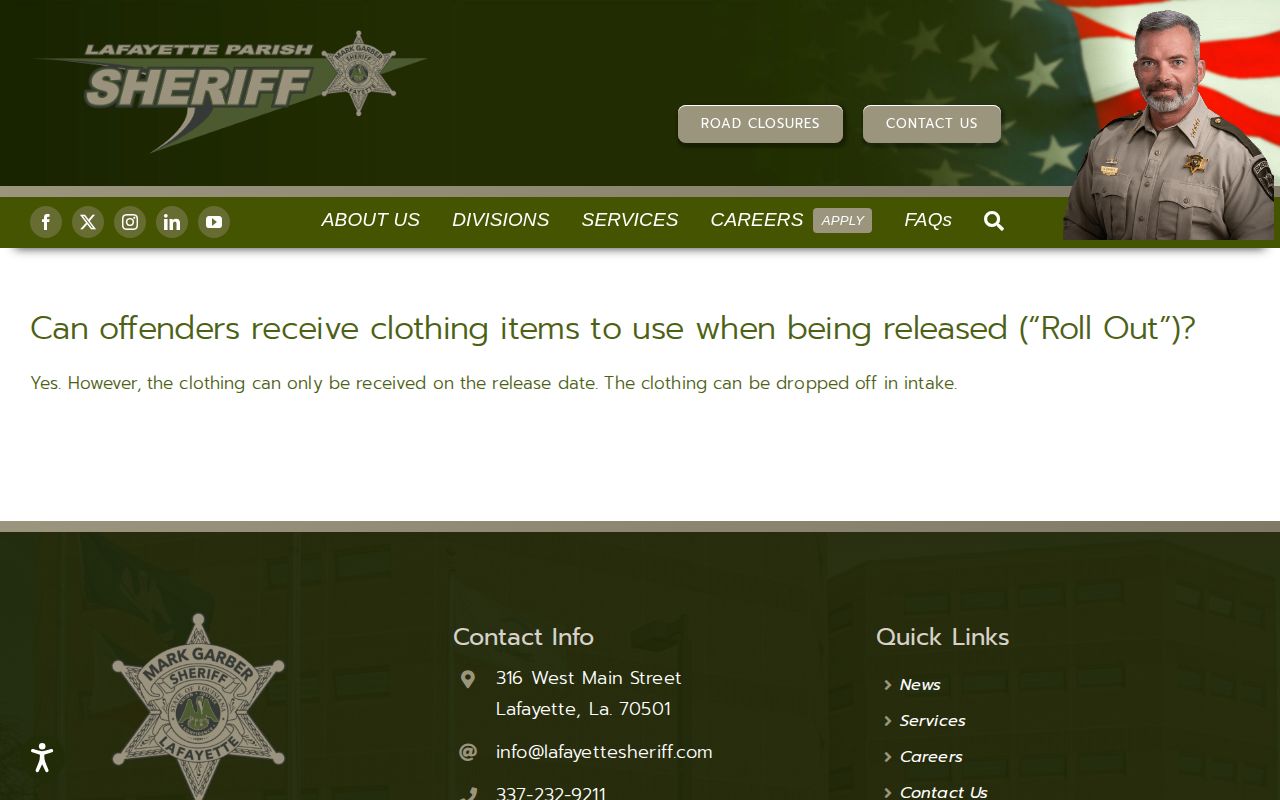
That narrow rule can help with release-day preparation, but it must not be stretched into a promise about when processing will finish.
Getting Home After Lafayette Release
LPSO Community Corrections transitional coordinators connect people leaving corrections with transportation and other services. The official program material does not name a bus route, set ride schedule, rideshare procedure, or pickup point. The accurate local path is to ask the program coordinator about current arrangements rather than assume a general transportation plan.
The Corrections Programs page describes the transition and reentry role.

The program can support a planned return, though program contact or participation is not evidence that an actual custody exit occurred.
Find Lafayette Parish Released Inmates
A branching search answers three separate questions: whether the person remains at LPCC, whether another system took custody, and which record proves a true release or discharge. Start with firm identifiers. Use a booking number when possible because LPCC processes a large volume of municipal and parish arrests, and people can share names.
- Search the LPSO 365Labs portal for current custody. Disable “Recent Bookings” when checking the complete current-custody set.
- If no current match appears, search Louisiana LAVNS by name or ID and compare the reporting agency, status, and location.
- Call the DPS&C locator at 225-383-4580. A facility assignment points to custody; a Probation and Parole assignment supports community supervision.
- Review Lafayette ClerkConnect or request criminal minutes for bond, dismissal, sentence, time-served credit, remand, or another judicial action.
- When federal custody is relevant, search BOP and the Western District of Louisiana docket. When an immigration handoff is supported, use ICE ODLS.
- Request the LPSO release event, or the public DPS&C discharge date for a completed state case.
For a named person, the order matters more than repeatedly searching one roster. The Lafayette Parish Released Last 24 Hours page explains the same-day fallback when no official release feed exists.
Louisiana Search After Lafayette Release
Louisiana DPS&C routes its public web lookup to LAVNS through VINELink. The system includes imprisoned people and people under probation or parole supervision and is described as updating every 24 hours. This is especially useful when an LPCC disappearance is really a state transfer or when physical prison release leads to supervision. Coverage follows legal custody, so a DPS&C-sentence person may be housed in a local building and still belong in state records.
| Channel | Search input | Useful result |
|---|---|---|
| LAVNS/VINELink | Location, name, ID or case number | Custody status, reporting agency, location, or community supervision |
| DPS&C phone locator | DPS&C number, or name plus date of birth | Custody assignment, facility contact, projected release date, or assigned district |
| DPS&C records request | Correct person and specific public field | Discharge date and other information listed by statute |
The DPS&C Inmate Information page explains the Louisiana locator routes.
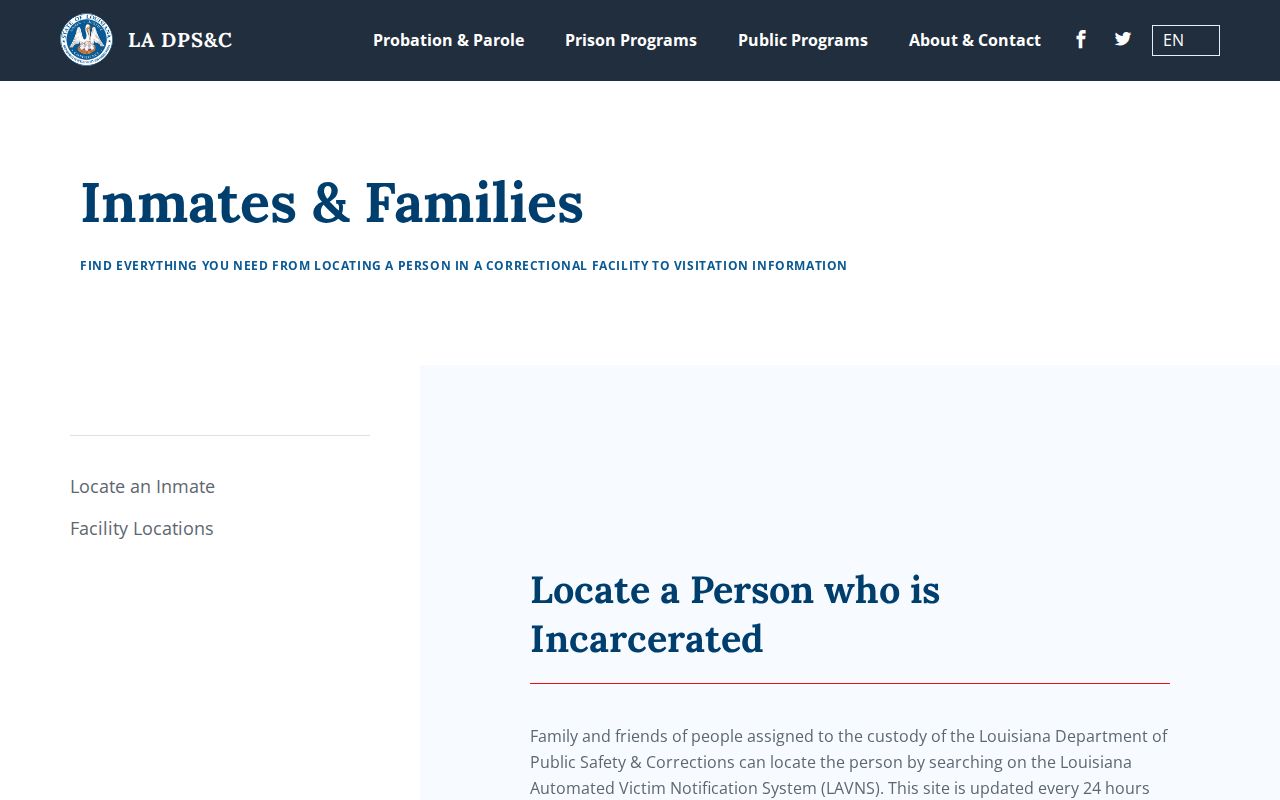
A projected release date shown through the phone locator remains a forecast. An assigned supervision district is stronger evidence of physical release, while the discharge date marks a later endpoint.
Lafayette Parish Recent Release Search
Lafayette Parish does not publish an official 24-hour or 72-hour release feed in the reviewed instructions. The account-gated 365Labs Community Portal replaced JADES. Its documented modes are all currently housed people and people booked within the last 72 hours. “Recent Bookings” is an intake window, not a list of who left. The instructions do not establish a release-only filter, release timestamp, retention period, photo behavior, or update cadence.
The LPSO Offender Information page distinguishes current custody from 72-hour bookings.

For a past-day or weekend group, ask LPSO Records whether a date-bounded release log or report exists, what fields it contains, and what it costs. Do not buy a Daily Booking Report expecting release events.
Lafayette Court Records After Release
Lafayette ClerkConnect can preserve criminal and traffic offense dates, charges, case history, service, minutes, and disposition after a name is gone from the live jail search. Court minutes may explain bond, dismissal, sentence, or time-served credit. They still do not establish the exact physical exit or clear unrelated holds.
The Lafayette Clerk online-records page describes ClerkConnect access.
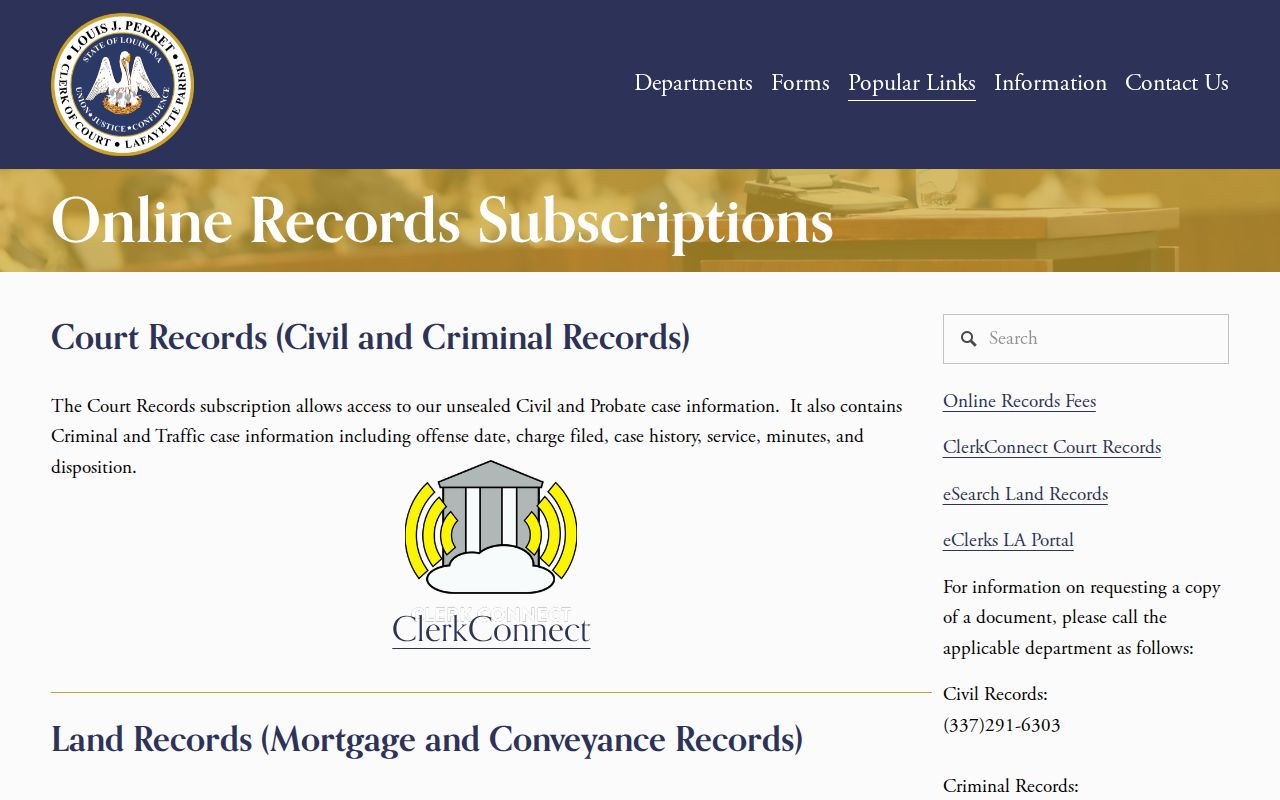
Pair the docket with the sheriff event or receiving locator. That two-source check keeps a case outcome from being mistaken for proof of total release.
Lafayette Regional Reentry Release Path
LPSO operates the Southwest Central Regional Reentry Program for DPS&C offenders housed locally and returning to Acadia, Allen, Evangeline, Iberia, Lafayette, St. Landry, St. Martin, St. Mary, or Vermilion Parish. Participants may reside at the Direct Supervision Unit or LPCC and receive the 100-Hour Pre-Release Curriculum plus other programming.
Participation shows preparation, not an actual release. A state-sentence participant’s status should still be checked in LAVNS or through the DPS&C locator. The later appearance of a current Probation and Parole assignment supports release to supervision, while the actual discharge date records completion.
Lafayette Expungement and Release Visibility
The Lafayette Clerk publishes local multiple-payee expungement instructions and a special path for an eligible first-offense marijuana matter. Louisiana law treats the expunged record as including photographs and disposition. It is removed from ordinary public access without being destroyed. A missing photo, case, or release entry may therefore reflect confidentiality rather than the absence of an underlying event.
The Lafayette Clerk expungement page gives the local filing framework.
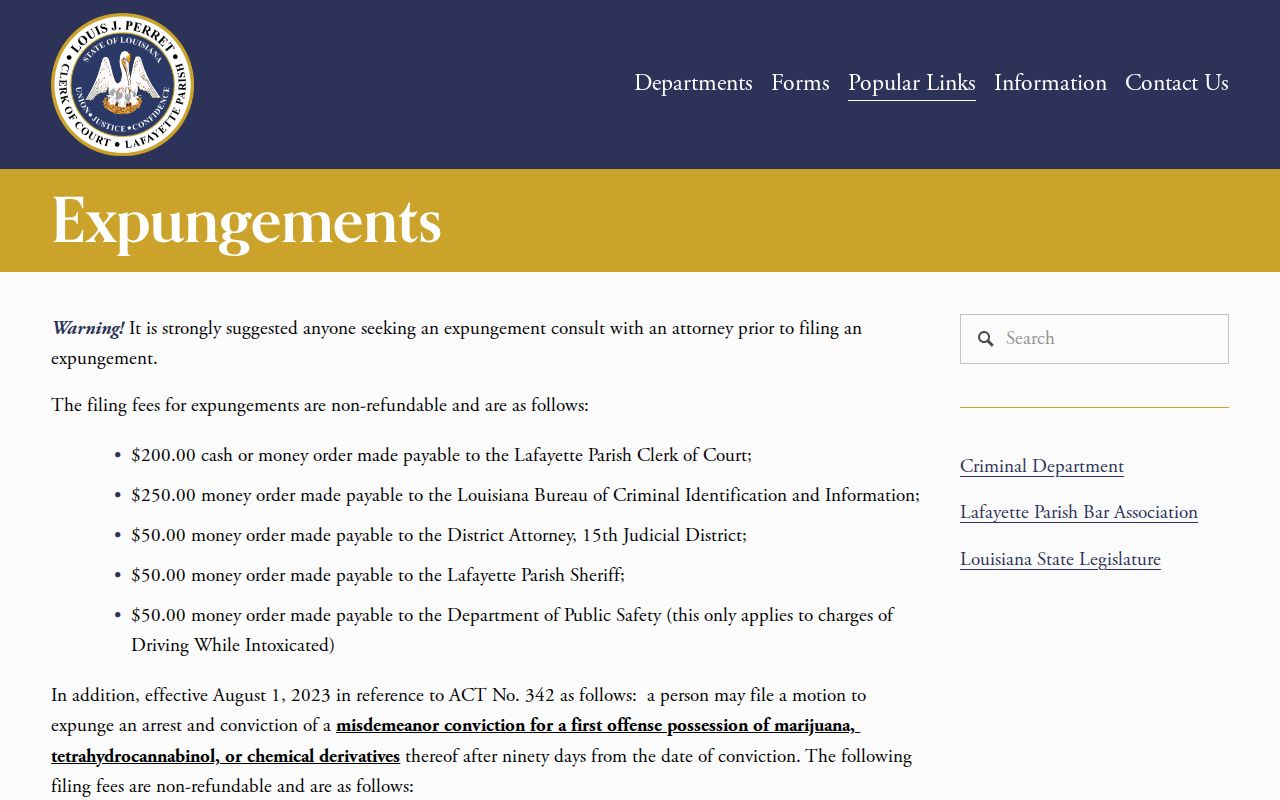
Use the court order and current statute to address access or correction. A public search should not be used to route around a lawful restriction.
Lafayette Release Alerts and Transfers
LAVNS can send a status-change notice for the correct matched record. LPSO advises searching VINE by booking number if its green handoff does not find the person. A VINE event is a timely lead, but the data can lag and the event speaks only for the reporting agency. Louisiana also warns that LAVNS registration and Louisiana Victim Outreach registration are separate. State projected and actual release notices may require the second process.
Federal and immigration paths use different tools. The BOP locator covers federal prisoners from 1982 forward and may show a release date or “Not in BOP Custody.” That wording ends only BOP custody. ICE ODLS covers current detainees and, according to ICE, releases within the past 60 days. An ICE result still may not distinguish a community placement, transfer, or removal. USMS movements tied to the Western District of Louisiana should be reconciled with the federal docket.
Where Lafayette Release Status Appears
Each source answers a limited question. Read the supplying agency and the date checked. A result that is strong for one custody system cannot rule out another.
| Source | What it can establish | Key limit |
|---|---|---|
| LPSO current custody | Current LPCC custody match | No match is not proof of release |
| LPSO release entry | When and how parish custody ended | Destination must still be checked |
| LAVNS/DPS&C | State prison or community-supervision status | Projected dates and daily updates can lag |
| Lafayette Clerk | Judicial basis and case disposition | May not show the exact exit time |
| BOP and federal docket | End of BOP custody and federal orders | Supervision or another custodian may follow |
| ICE ODLS | Current or recent ICE custody status | Recent results age out and outcomes vary |
Question: Does a parole grant prove release? No. A Committee on Parole action may remain subject to prerequisites, recalculation, detainers, or later action. Check the later LAVNS status, district assignment, and actual release entry.
Lafayette Parish Release Facilities
LPCC is the parish custody hub and also provides booking, identification, and jail space for Lafayette city and other municipalities. The Direct Supervision Unit and Offender Processing Center support local placement and reentry work. Community Corrections handles programs and transition coordination. State, federal, and immigration pages cover systems that may receive someone after local custody.
The annual LPCC figure is intake throughput, not a current population or release count. LPSO also reports initial American Correctional Association accreditation on August 1, 1988 and reaccreditation at each assessment, providing verified history for the parish’s central booking role.
- Lafayette Parish Correctional Center (LPCC)
- Lafayette Parish Sheriff's Office Direct Supervision Unit (DSU)
- Offender Processing Center
- LPSO Community Corrections / Programs
- Lafayette City Police temporary holding/booking path
- Other Lafayette Parish municipal arrest/holding paths
- Louisiana state-custody placements serving Lafayette cases
- U.S. Marshals Service contracted custody / Western District of Louisiana
- Immigration and Customs Enforcement custody
For every Lafayette Parish released inmate search, follow the destination shown by the record. A transfer between buildings or legal custodians is a change in location, not proof that the person entered the community.