
Lafayette Projected and Actual Release
Louisiana uses the exact term projected release date. It is a forecast calculated from the sentence, credit for time already spent in custody, offense date and category, eligibility, credits earned, credits lost or restored, court orders, and other holds. The forecast can move. An actual release record instead documents that a named custodian ended physical custody at a specific event.
A pretrial LPCC detainee often has no computed sentence date. Bond may create legal authority for release, but processing, another warrant, a state commitment, or a federal or immigration hold can still prevent a community exit. A sentenced parish prisoner may have a sheriff-computed date. A DPS&C-sentence person may be housed locally yet remain a state prisoner whose applicable projected date comes from Louisiana corrections.
Find Lafayette Projected Release Dates
Start with custody class. LPCC handles parish custody and municipal bookings. Louisiana DPS&C controls state sentences even when the physical bed is in a parish facility. The court supplies sentence and bond authority. Each source answers a different part of the date question.
For state custody, the DPS&C Inmate Information page directs Internet searches to LAVNS and provides the 24-hour automated Imprisoned Person Locator at 225-383-4580. The locator takes a DPS&C number, or name plus date of birth. DPS&C says it can return the facility assignment, facility address and phone, and projected release date when applicable.
- Confirm the person's complete name and the strongest available ID, booking, DPS&C, or case number.
- Check current LPCC custody for a parish detainee or LAVNS for a state-sentence person. Do not treat absence as release.
- For a DPS&C record, call 225-383-4580 and record the exact projected date, facility, and lookup date.
- For a parish sentence, ask LPSO Intake and Booking or Records for the current sentence-release calculation and custody event.
- For a pretrial case, read the Lafayette court minutes for bond or release authority, then check whether another hold remains.
- On or after the forecast, recheck the live custodian and request the actual release or discharge entry.
The Lafayette Parish release-record workflow on the home search page shows how to follow a person who disappears from one system into another custody channel.
Note: Preserve the date and Central-time context of each lookup because a future forecast and a live status can change on different schedules.
Lafayette State Release Date Locator
LAVNS covers imprisoned people and people under probation or parole community supervision, and DPS&C says it updates every 24 hours. It is useful for deciding whether the state still reports a prison facility or has moved the person to supervision. The telephone locator is the documented source for the projected date field. Neither system replaces the public discharge date when the question is whether the whole state term ended.
The official DPS&C page pictured below explains the locator and state notification path. Open the current Inmate Information source to verify the phone route before relying on an older saved image.
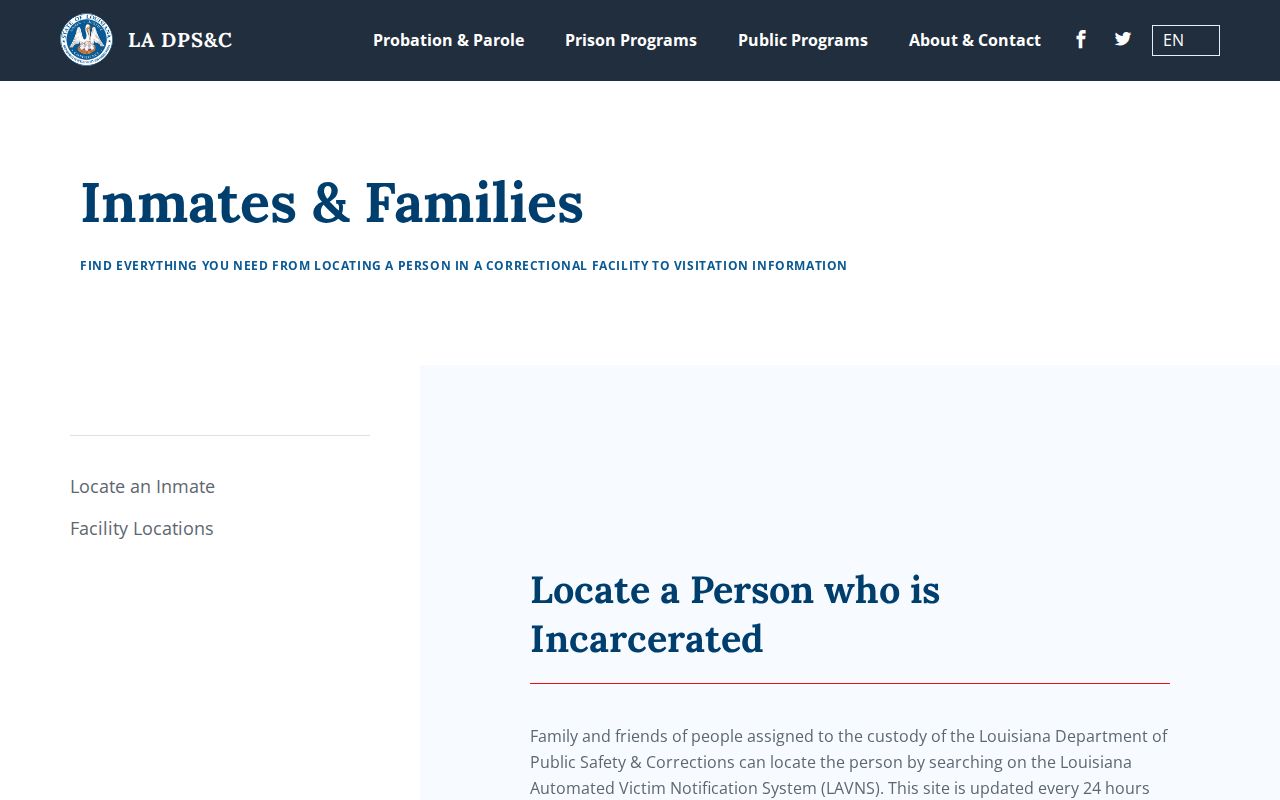
The capture supports the state lookup method, while the fresh phone result supplies the person's current projection.
| Locator result | What it means | What to do next |
|---|---|---|
| Facility assignment | DPS&C reports confinement at that location | Use the current projected date only as a forecast |
| Projected release date | A computed state date, if applicable | Record retrieval date and later verify the event |
| Assigned P&P district | Supports community supervision | Confirm current status with the assigned office |
| Discharge date | Public endpoint for completed state custody or supervision | Request under the cited public-information statute |
Lafayette Release Date Law Split
August 1, 2024 is a major dividing line in Louisiana release computation. Older offenses remain subject to the detailed category rules in R.S. 15:571.3. For eligible felony offenses committed on or after that date, R.S. 15:571.3.1 caps ordinary good-time diminution at 15 percent of the sentence. Good time is credit that can reduce time served when the person and offense qualify.
The phrase “serve 85 percent” is only the inverse of that maximum post-date credit. It is not a universal release rule or guaranteed date. Sex-offense convictions and Habitual Offender Law sentences are among excluded categories, and other eligibility limits apply. The offense date, statute of conviction, sentence, and classification must all be checked before using any percentage.
Parole is a separate decision path. R.S. 15:574.22 generally limits ordinary parole for offenses committed on or after August 1, 2024, subject to cross-referenced exceptions. Earlier offenses use the more complex framework in R.S. 15:574.4, with varying thresholds and exclusions. Good-time eligibility and parole eligibility must never be merged into one formula.
Lafayette Parish Good-Time Computation
Parish and state rules are not interchangeable. Under the older framework, a parish prisoner sentenced without hard labor may generally earn thirty days of diminution for thirty days in actual custody, while a first crime of violence has a different three-days-per-seventeen rate. The sheriff determines the lawful credit. DOC felony categories include other rates and restrictions for eligible cases.
The sentence imposed, credit for time already served, offense date, eligible category, earned credit, and any forfeiture all affect the computed endpoint. R.S. 15:571.4 permits forfeiture of good time, which can move the projection later. The complete statute and the actual sentence record should be used, not a web calculator or a rule of thumb.
No official Lafayette source established a weekend or holiday early-release practice. A projected Saturday or Sunday date does not justify promising a Friday exit. Call the legal custodian and ask how that specific sentence will be processed.
Note: County sentence credit belongs to the sheriff's lawful computation; state sentence credit remains a DPS&C matter even when the person sleeps locally.
Lafayette Parole Eligibility Dates
Parole eligibility is not the same as a projected release date. For qualifying older offenses, R.S. 15:574.4 contains several thresholds. Some eligible nonexcluded cases may reach consideration at 25 percent, a first crime of violence may use 65 percent under stated conditions, and certain second violent or first or second sex-offense cases may use 75 percent. Other exclusions and rules can control. The actual statute, offense date, and sentence record must be checked together.
A hearing date is also not an exit date. The Committee on Parole may grant, deny, defer, rescind, or take another documented action. Even after a grant, prerequisites, recalculation, another hold, or later board action may intervene. The later LAVNS status and assigned P&P district are stronger evidence that physical release to supervision occurred.
Someone released to parole remains under legal supervision for the balance set by law. Final discharge is a later milestone. Asking for the public discharge date under R.S. 15:574.12(G) answers a different question from asking when parole eligibility first arose.
Lafayette Release Dates Can Change
A forecast may move earlier or later for a documented reason. When a projected date has passed but the person still appears confined, the live custody result controls over the old forecast. Recheck identity first. Then ask the locator or records custodian for the current projection and the releasable disposition information rather than selecting a cause without evidence.
| Factor | Possible effect | Best verification |
|---|---|---|
| Credit earned or restored | May move a date earlier within lawful limits | Current custodian calculation |
| Good-time forfeiture | May move the date later | DPS&C or sheriff disposition |
| Court order or sentence correction | May change the term or credit | Signed order and clerk minutes |
| Detainer or another hold | May prevent community release at one sentence endpoint | Custody record and receiving locator |
| Parole action | May authorize supervised release, deny it, or defer it | Board result plus later LAVNS status |
| Transfer | Ends one facility stay without ending incarceration | Receiving agency or facility assignment |
A parole grant can remain contingent. A bond entry may coexist with another warrant. A completed parish sentence can lead to DPS&C, USMS, or ICE custody. For that reason, the release destination matters as much as the first date.
When Lafayette's Projected Date Passes
Do not appear at a facility based solely on a predicted date. If the date has passed, rerun the correct live search and save the time of the lookup. Call the DPS&C locator for a state sentence or LPSO Intake and Booking for parish custody. Ask whether the person remains confined, transferred, or has a recorded release event.
Possible explanations supported by the Lafayette research include lost good time, a recalculation, a different eligibility category, a court change, or another hold. The sources do not permit choosing among them without a record. A direct current-custody result is stronger than an older projection, while a release entry or assigned P&P district is stronger evidence of an actual physical exit.
Confirm Lafayette Actual Release Dates
For LPCC, request the sheriff's custody/release transaction with the date and time custody ended, release code or disposition, authority, and destination or receiving agency if recorded. LPSO Records manages inmate files. The official channels are in person, email to recordsrequest@lafayettesheriff.com, or U.S. mail to the current address on its Records page. Requests sent another way may not count as received.
For a state sentence, R.S. 15:574.12(G)(1)(a) makes specified data public, including the discharge date. Ask narrowly for that field instead of an entire restricted case file. A community-supervision assignment means the person is outside physical prison custody but not necessarily discharged. The Lafayette VINELink Release Check can supply an alert or status lead, but the agency record remains the stronger final source.
A court minute can show bond, dismissal, sentence, time-served credit, remand, or another judicial act. It may not show the exact gate time and cannot rule out an unrelated hold. Pair it with the physical custody endpoint before describing an actual Lafayette Parish release date.
If an LPSO date appears wrong, contact Records with the booking number and the precise field in dispute. A court sentence or credit error belongs with the Clerk department tied to the docket. For a DPS&C projection, begin with the locator or source office because LAVNS republishes agency data. Each correction must go to the office that owns that part of the record.